
Blog#
A napari GUI for manual tracklet refinement in movement - Final GSoC Report by Anna Teruel-Sanchis, September 04, 2026
Hi, I’m Anna. I’m a neuroscientist interested in the study of social behaviour. During my PhD I started using different open-source pose estimation tools, such as DeepLabCut, to track animal behaviour. Working with real, multi-animal recordings, I kept running into the same problems: occlusions, noisy detections, and identity swaps that no automated pipeline could fully resolve. Programmatic corrections improved the data, but visual inspection and manual correction were always necessary, and the tools available for that were slow and hard to scale to large datasets.
GSoC 2026: Miscellaneous maintenance work on BrainGlobe overall infrastructure by Varun Singh, August 26, 2026
Hi, I’m Varun. This summer I worked with BrainGlobe and the Neuroinformatics Unit as part of Google Summer of Code.

GSoC 2026: single-channel support in cellfinder by Soumya Snigdha Kundu, August 07, 2026
Hi, I’m Soumya. I was one of the Neuroinformatics Unit Google Summer of Code (GSoC) interns for the 2026 summer term, and I worked on broadening the range of inputs
cellfinderaccepts, in both channel count and dimensionality.Trusted by design (part 3): embrace radically open communication by Niko Sirmpilatze, February 11, 2026
Open-source software is public, yet much of the communication around it may happen in private emails, internal Slack channels and meetings with no minutes. This disconnect can erode the very trust that openness is meant to build. What if communication were radically open—a habit of constant, multi-way interactions visible to anyone who cares to look?
Trusted by design (part 2): release early, release often by Niko Sirmpilatze, February 04, 2026
‘Release early, release often’ is an often-repeated mantra, popularised by Eric S. Raymond in his 1997 essay “The Cathedral and the Bazaar”. I hadn’t fully grasped its significance until I switched from academic research to full-time software development. How early? How often? And why is this so critical to establishing and maintaining trust?
Trusted by design (part 1): define your software’s mission and scope by Niko Sirmpilatze, January 28, 2026
No project exists in a vacuum. Open-source software is a vast web of inter-connected and inter-dependent tools. When creating a new tool, your number one job is to carve out its place in the web consciously, openly and from the outset. How can you approach that?
Trusted by design (intro): set up your research software for community adoption by Niko Sirmpilatze, January 28, 2026
So, you want to create an open-source research software package—and not just for yourself or your group. You’d like people around the world to use it, and even contribute to it. How do you persuade them it’s worth their time?
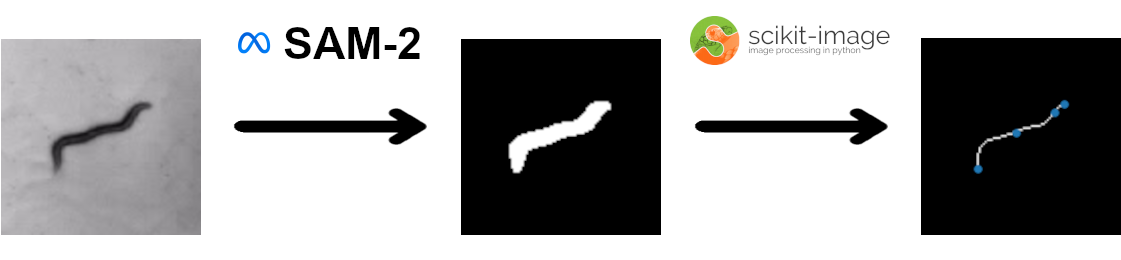
Exploring automatic ways of extracting a pose estimation skeleton for C. elegans by Pille Wetterauer, Jyoti Bhogal, December 03, 2025
Segmenting C. elegans using SAM-2 and extracting skeletons.
GSoC 2025: brainglobe-registration by Saarah Hussain, September 15, 2025
Hi, I’m Saarah. The intersection of healthcare and software development has always been important to me, which is why spending my summer with the Neuroinformatics Unit has been the perfect opportunity to bring together the work I love.
Add Google Drive and AWS to datashuttle - Final GSoC Report by Shrey Singh, September 12, 2025
Hi, I am Shrey. This summer, I had the opportunity to contribute to open-source neuroscience software through Google Summer of Code — a program that connects student developers with mentoring organizations to work on real-world projects. I worked with the Neuroinformatics Unit to enhance
datashuttle, a tool for the creation, validation and transfer of neuroscience project folders.